Lawrence Hill‘s The Book of Negroes is filled with many archetypes. So after having finished his book, I thought it would be a fun idea to analyze his text using archetypal literary theory.
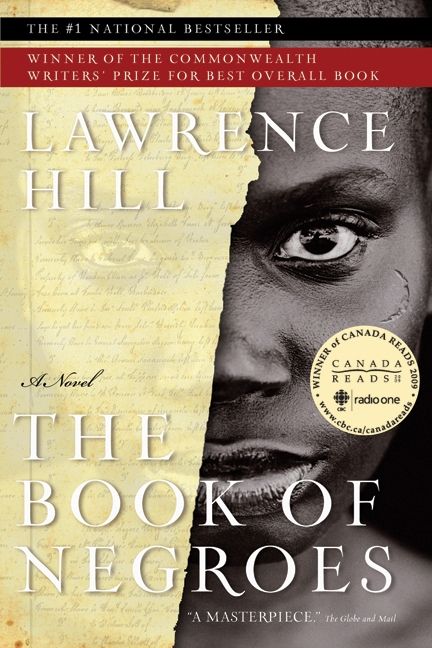
If I were to assign archetypes such as ‘The Hero’, ‘The Great Mother’, and ‘The Wise Old Man’ to the characters in the book it would go like so: Aminata as ‘The hero’ and how she followed the ‘Hero’s Journey Wheel’, Georgia as ‘The Great Mother’, and Daddy Moses as ‘The Wise Old Man’.
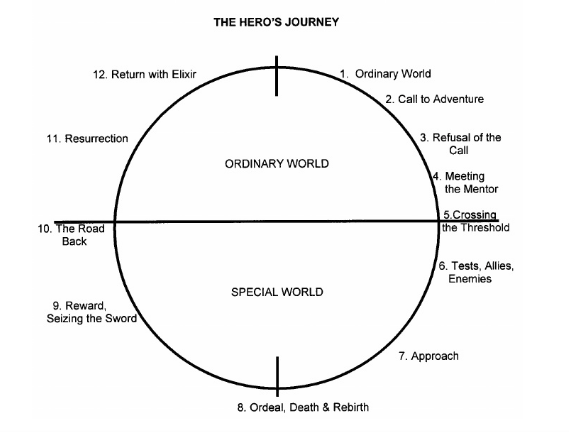
I will use the ‘Hero’s Journey Wheel’ to analyze Aminata and the journey that she explores. I will try to stay as true as possible to the ‘Hero’s Journey Wheel’. Aminata loops the wheel several times throughout the book and the book itself is a massive wheel. The most notable ones are: when she is crossing the Atlantic, when she was working on a plantation in South Carolina, and when she traveled to Nova Scotia.
Aminata may not be the traditional hero, but she very well closely resembles “the underdog” type hero. Aminata’s story mirrors that of the ‘Hero’s Journey Wheel’. In such that Aminata begins in familiar grounds – her home in the village of Bayo in Africa – whence Aminata is stolen away from her home, she begins the journey from innocence to experience. Aminata has encountered many life-threatening events, from scorpions to baboons to the harsh environment of the sea and the poor conditions that ships in the 17 hundreds were in.
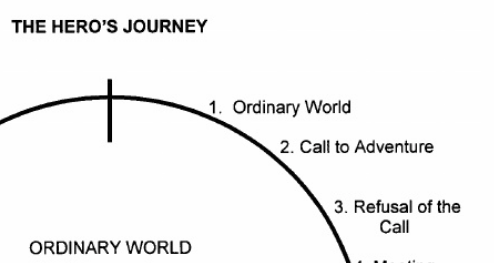
Aminata’s ‘Call To Adventure’ isn’t a call, rather she was forced onto the journey by slave-traders. Which also was her ‘Refusal Of The Call’ since Aminata didn’t go willingly. Aminata, before she was captured, had her parents guide her and give her life lessons. During the entire ordeal, Aminata remembers what her parents taught her and reassures herself in that way.
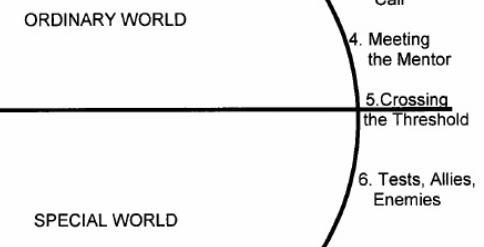
Aminata crosses ‘The Threshold’ several times. The most notable one being when she got on the boat to be taken to Bunce Island, where her allies were the enslaved from Africa and her enemies were the slave-traders who Aminata had to comply with. Aminata’s dangerous test was to survive on a ship full of feces, urine, and bodies; she had to endure see-sickness, the weather and the treatment of the sailors (Hill 67).
Aminata’s ‘Death & Rebirth’ happened when the slaves tried to rebel and broke out into a fight. Aminata quickly finds herself caught in the crossfire and pinned down by a corpse while her hair was pierced by a sword; “He [the corpse] tumbled over me, covering me, bleeding on me, pinnig me.” (Hill 91) The ‘Rebirth’ part happened when her body was about to collapse, Georgia (The Great Mother) tends to her on Robinson Appleby’s plantation. Now instead of receiving a reward, Aminata starts over again at the ‘Tests, Allies, Enemies’ part of the wheel. The enemies and allies remain the same, except their names change, and Aminata’s test is surviving the weather of South Caroline, enduring RobinsonAppleby’s abuse and working on the plantation.
As a ‘Seizing The Sword’ archetype, Aminata is now rewarded by learning to read, speak and write proper English. Something that only less than a few blacks were able to accomplish.
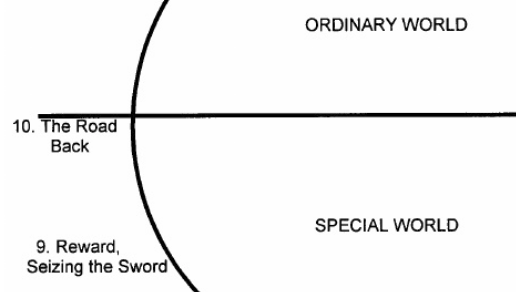
Aminata’s ‘The Road Back’ archetype is when she became the grand Djeli, storyteller, of the school her daughter owns (Hills 469). Aminata, after traveling practically half of the entire world, comes to rest in London, England. There she is reunited with her long lost daughter as the ‘Seizing The Sword’ archetype. As for the ‘Return With Elixir’ archetype, Aminata writes an autobiography, detailing everything Aminata experiences and learns, and publishes it for the world to read as means of ending the trade-in-slaves.
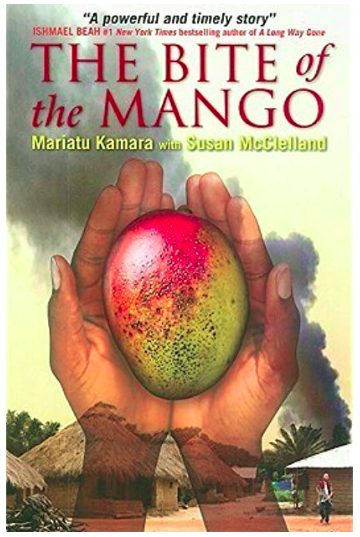
While reading this book, Aminata’s circumstances reminded me of the protagonist in The Bite Of The Mango. The protagonists of both books are both Africans girls that are on the hunt and have somewhat of a tie the Islamic religion. Both protagonists manage to find their way into North America all the way from Africa while surviving on there own.
I thought Georgia would fill ‘The Great Mother’ archetype, Georgia is the first person Aminata trusts after her enslavement. Georgia grew up on the plantation field, giving her insight that Aminata doesn’t have. Georgia becomes the caretaker of Aminata and almost a second mother. Georgia protected and looked over Aminata, Georgia taught her the language of the Negroes, how to bargain and what herbs are useful as medicine. Georgia also introduced Aminata to the “Fish Net” – a system for blacks to secretly connect, share and communicate with others across a wide range (Hill 141). Georgia wanted the best for Aminata but knew her intellect can harm her: “‘But watch out, girl. You know too much, someone kill you'[Georgia said]” (Hill 143). Georgia taught Aminata the lifestyle of slaves, just as Aminata’s mother taught Aminata the lifestyle of the villagers.
If was to compare Georgia to another ‘The Great Mother’ character. The most prominent example is the godmother from Cinderella. Georgia, very clearly, plays a supportive mother-like role in Aminata’s life by reviving Aminata’s spirit and teaching her the values needed to survive. Similarly, the Godmother in Cinderella lifts up Cinderella’s spirit by getting Cinderella to the ball.
Daddy Moses very well portrays ‘The Wise Old Man’. Daddy Moses is a blind priest of a small chapel. Daddy Moses teaches Aminata how to build up her spirit and how to stay positive. Though Daddy Moses is a preacher of Christian faith and Aminata is Muslim, Aminata still grew attached to him because of his loving soul. “He [Daddy Moses] took my [Aminata] hands and turned me as if he could see deep into my eyes [(Daddy Moses is blind)]. ‘But you are good, Meena. So many people love you.'” (Hill 350). This just goes to show how wise he is since he does not need to see to teach others, instead Daddy Moses teaches off of his experience.
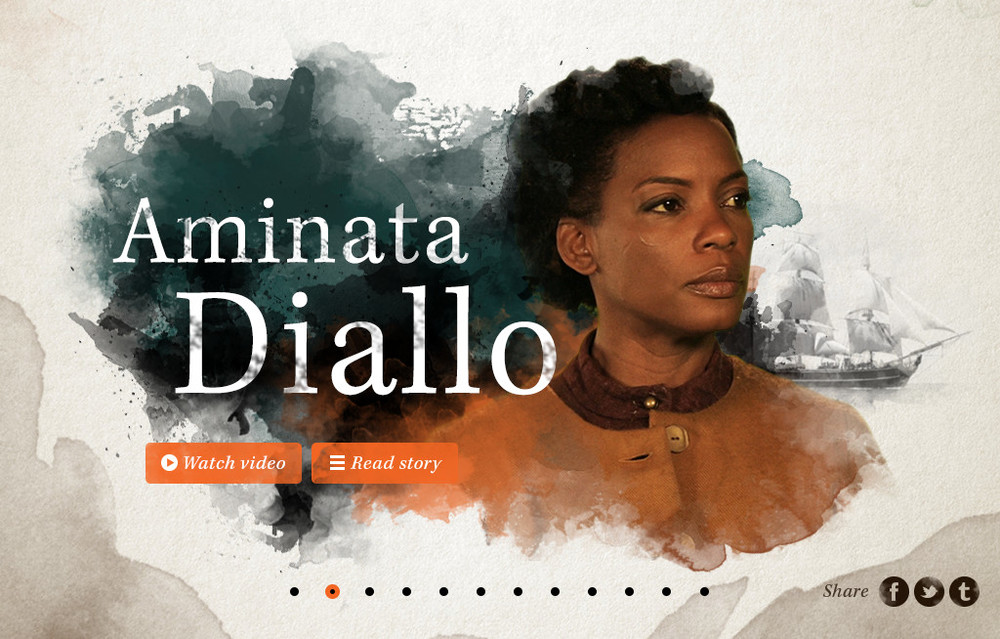
The crescent moon etched on Aminata’s face is also an archetype. Crescent moon is the symbol of change and transition. Throughout the entire book, Aminata is also moving homes, towns and even Continents. This happened so many times that Aminata acknowledges this saying “‘We [blacks] are travelling peoples, as you say so well, and you [Aminata] are one of the travellest of them all'” (Hill 319).
_________________________________________________
Works Cited
- “Archetypal Literary Criticism.” Scribd, Scribd, http://www.scribd.com/document/253907931/Archetypal-Literary-Criticism.
- (GIF) Anonymous. “Cinderella (1950) – Create, Discover and Share Awesome GIFs on Gfycat.” Gfycat, 29 Aug. 2015, gfycat.com/fragrantblackargentinehornedfrog.
- Hill, Lawrence. The Book of Negroes. Atlantic Provinces Special Education Authority, Library, 2017.“Lawrence Hill Author.” Lawrence Hill, http://www.lawrencehill.com/.
- (Photo) “Archetypal Literary Criticism.” Scribd, Scribd, http://www.scribd.com/document/253907931/Archetypal-Literary-Criticism.
- (Photo) “The Bite of Mango by Mariatu Kamara.” Goodreads, Goodreads, 30 Sept. 2008, http://www.goodreads.com/book/show/3764130-the-bite-of-mango.
- (Photo) “The Book Of Negroes – Lawrence Hill – Paperback.” HarperCollins Canada, http://www.harpercollins.ca/9781554681563/the-book-of-negroes/.
- (Photo) “The Book of Negroes.” Mark Rozeluk, http://www.markrozeluk.com/bon.
- “The Book of Negroes.” Lawrence Hill, http://www.lawrencehill.com/the-book-of-negroes.
- Wiley, Moore. “Archetypes and Symbols.” Archetypesandsymbols, moorewiley.weebly.com/uploads/1/3/2/8/13284226/archetypes_and_symbols.pdf.
 Ahmad's Blog Posts